Showing posts with label Haiti. Show all posts

Sunday, January 17, 2010

Haiti and Me -II :Someone To Watch Over Me

drawing/collage by marguerita


Traveling through this life,embattled since a little girl,nearing my sixtieth year , I dare look back, as I am always doing. Facing obstacles beyond one's imagination,somehow scary and devastating. For the one who will lend his or her ear, or reading my words here ,seems to them and even to me fiction.
Watching Haiti's tragedy and the ones with their wonderful faith,I see them as looking in my mirror.
I can imagine that for many as, I myself,are in disbelief of one being so strong and looking at reality with no fear.I was maybe,fortunate to learn from my two parents,my mother out of Auschwitz and my father out from Siberia, both from cultured and prominent backgrounds,wealthy,to have lost all,but face the remains of their lives with an incredible joie de vivre,looking for Beauty and securing my mind to stand up for justice,never to harbor anger, see life through humor and colors,carpe diem,as I could hear my father's tick tack,writing on his typewriter,always in pursuit of his passion,Chemistry and Innovation in Textiles.
He was also an inventor.
My mother was an artist.
She loved to paint watercolors and always reading Chinese writers and philosophers.
Both,my parents ,intellectuals, believed to look at life with passion, having an interior monologue, to be au courant of what is happening around, reminding themselves, about what they were taught by their ancestors.
Life is not about material things. They had it all,and lost it all.
Not by their actions, but by human calamity.

By Hitler and Company.

My mother,on the other hand,despite our chaotic finances,we never felt or saw ourselves as poor. When I was ten years old, witnessing

my father collapse in the street,he contracted malaria,in the gulag

during the II WW, I realized at that moment that I had to jump into

adulthood.

My mother had dreams of me being a concert pianist.

She wanted me to be beautiful dressed,soigne.

Until her last moment,my mother herself

was always very elegant ,


exuberant,humorous and a good sport.


The number A-26.427 was


always there on her arm.


She had no wrinkles at seventy seven.

My drawing prevailed. I looked at my hands and thought to myself.

That is how I am going to earn my living and take care of myself and my parents.

Even now, facing to be once again, homeless and destitute,despite my past successes,I have faith that my

art,will be my passport and secure me to stand up on my feet.


Today is a good day to remember that in Haiti, nobody ever really dies. The many thousands who've had the breath crushed out of their bodies in the earthquake, and the thousands more who will not physically survive the aftermath, will undergo instead a translation of state, according to the precepts of Haitian Vodou, some form of which is practiced by much of the population. Spirits of the Haitian dead — sa nou pa we yo, those we don’t see — do not depart as in other religions but remain extremely close to the living, invisible but tangible, inhabiting a parallel universe on the other side of any mirror, beneath the surface of all water, just behind the veil that divides us from our dreams.

That extraordinary spiritual reservoir is the source of the Haitian religious view of the world — as powerful as any today. As often as it is misunderstood and misrepresented, Haitian Vodou, with all it carries out of the cradle of humankind’s birth in Africa and combines with Roman Catholicism, has enabled Haitians to laugh at death, as they have too often needed to do.

During the decade-long Haitian revolution that began in 1791 — the only event in human history where African slaves won freedom for themselves by force of arms — a prisoner of the French was awaiting execution by burning. Come, he is supposed to have said to his companions, let us show these people how to die. He climbed onto the pyre himself and stayed there, without uttering another sound, until the fire consumed him.

The energy of souls not lost springs back into the living world, not only through one of the few surviving religions that allow believers to converse face to face with the gods, but also in an extraordinarily rich, fertile and (in spite of everything) optimistic culture. Haiti offers, keeps on offering, a shimmering panorama of visual art and a wealth of seductive and hypnotic music, much of it rooted in the rhythms of ceremonial drumming. For the past 50 years a remarkably vivid and sophisticated Haitian literature has been flowing out of Creole, an ever-evolving language as fecund as the English of Shakespeare’s time. The Haitian world is not all suffering; it is full of treasure. Here are a few of the many voices, native and not, inspired by Haiti. —Madison Smartt Bell

http://www.nytimes.com/2010/01/17/weekinreview/17bell.html?ref=global-home

http://www.nytimes.com/2010/01/21/opinion/21kristof.html


Saturday, January 16, 2010

Haiti and Me asks: is anybody coming to help?

from my window inTribeca- photo by marguerita
The home I had began to build.The blue door I painted,the walls and the floor I created and put down with my own hands,my love for a man who never was able to understand ,the family I devoted myself and my art....I must remind myself:

Haiti and me: We’re strong, and despite the hunger, despite the poverty, despite all the problems, we’ll make it through.”Being the daughter of two Holocaust survivors,having no family alive, I lost my father at 17,became a mother to my own mother, I adored my parents, lost them and my husband, and children who turned out like him are to be considered gone from my life.Like an Earthquake, a man incapable of loving and being gentle,in fact otherwise, I am in grief.


collage/drawing/photos by marguerita

One of the most powerful of all creative urges is to memorialize.


treble clef graphicThe results can range from the trivial statues of mounted generals that clutter our parks to the awe of the Pyramids. Yet, perhaps the most powerful creations are those which try to overcome a grievous personal loss by immortalizing the evanescent.

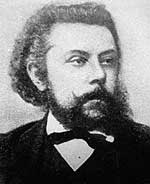
Modeste Mussorgsky produced his Pictures at an Exhibition to perpetuate the memory of a friend. In the process, he created a monument far more massive and lasting than his subject.

Mussorgsky was an ardent Russian nationalist,

Portrait of Modeste Mussorgsky
Modeste Mussorgsky
Yet, his soul was far less complacent than one would expect from a life-long bureaucrat – he lived in a commune and the radical ideology he absorbed there infused his music, as he devoted himself to seeking truth in art by crafting a natural style without classical artifice.

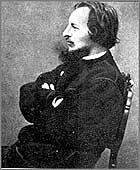
Victor Hartmann was a close friend who shared Mussorgsky's ideals in his own field of architecture and painting.

 Victor Hartmann
Victor Hartmann
When Hartmann died in 1874, aged only 39, Mussorgsky was devastated. In abject bitterness, he wrote: “Why should a dog, a horse, a rat live on and creatures like Hartmann must die?” But soon his incomprehension took a more constructive tack. The following year saw a memorial exhibit of 400 Hartmann works, including sketches, watercolors and costume designs. Mussorgsky was deeply moved. Seized with with inspiration, he quickly reacted to the exhibition by writing a suite of ten piano pieces dedicated to the organizer.The work opens with a brilliant touch – a “promenade” theme that reemerges throughout as a transition amid the changing moods of the various pictures. By alternating 6/4 and 5/4 time, its regular metric “walking” pace is thrown off-balance and cleverly suggests the hesitant gait of an art-lover strolling through a museum, attracted by upcoming pleasures but hesitant to leave the object at hand without a final glance at a telling detail.

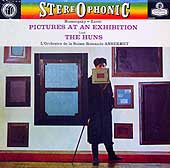
The ten pictures Mussorgsky depicts are:Ernest Ansermet conducts the Orchestre de la Suisse Romande -- London LP cover a gnome-shaped nutcracker; a troubadour plaintively singing outside an ancient castle; children vigorously playing and quarrelling in a park; a lumbering wooden Polish ox-cart; a ballet of peeping chicks as they hatch from their shells; an argument between two Warsaw Jews, one haughty and vain, the other poor and garrulous; shrill women and vendors in a crowded marketplace; the eerie, echoing gloom of catacombs beneath Paris; the hut of a grotesque bone-chomping witch of Russian folk-lore; and a design for an entrance gate to Kiev. Mussorgsky clearly chose these subjects for the variety of moods they invoked and the opportunities they presented for a wide array of musical depictions.

http://www.classicalnotes.net/classics/pix.html

Wednesday, January 13, 2010

HAITI; HELP

drawing by marguerita


Huge swaths of the capital, Port-au-Prince, lay in ruins, and thousands of people were feared dead in the rubble of government buildings, foreign aid offices and shantytowns. Limbs protruded from piles of disintegrated concrete, and muffled cries emanated from deep inside the wrecks of buildings, as this impoverished nation struggled to grasp the grim, still unknown toll from its worst earthquake in more than 200 years.

Scenes of destruction defined the city. Concrete homes collapsed on hillsides. Hospitals overflowed with victims. The Canape Vert hospital was surrounded by collapsed buildings.

With the electricity and phone service out and supplies of fresh water dwindling, The United Nations secretary general, Ban Ki-moon, said Haiti was facing a “major humanitarian emergency.”

The Haitian president, René Préval, told The Miami Herald that the toll was “unimaginable” and estimated that thousands had died. Among those feared dead were the chief of the United Nations mission in Haiti and Msgr. Joseph Serge Miot, the archbishop of the capital, Port-au-Prince.http://www.nytimes.com/2010/01/14/world/americas/14haiti.html?hp